Fidelis's war trauma
The Master Butchers Singing ClubFidelis’s war trauma is not a single remembered battle but a persistent conflict between what he did to survive, the people he could not save, and the silence he built around those experiences. A German sniper during the war, he carried his memories into civilian life without speaking of them, even to Cyprian, the fellow veteran with whom he had fought. The past nevertheless returned in fragments—an image, a sound, a word—and altered the quiet routines through which both men tried to continue. When Fidelis eventually tells Delphine what happened to Johannes, the account gives speech to a loss he had borne alone. Later, as Delphine confides in him, his own memories overwhelm his attention; after their encounter he recognizes that he has lost his former capacity for absolute stillness, but also that he no longer needs it to survive.
Silence Between Veterans
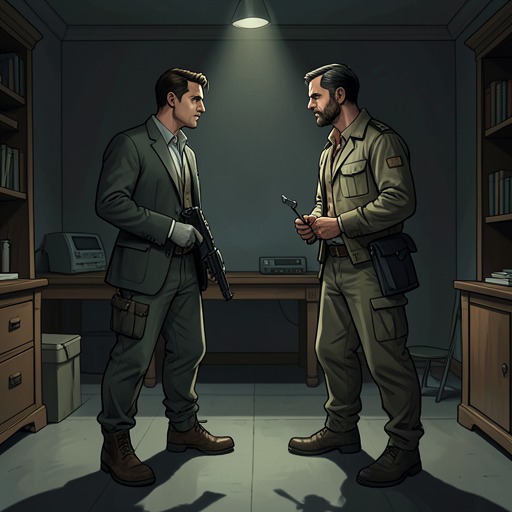
Fidelis and Cyprian never openly discussed the war they shared. Their silence did not mean that the experience had passed: each remembered it throughout the day, sometimes prompted by a picture, a sound, or a word. When a memory came, one man would pause and struggle inwardly before carrying on; the other sensed the disturbance and might answer with a joke or a long drink of beer. Their companionship thus included an unspoken recognition of each other’s pain, but not a direct account of its source.
When Delphine tells Cyprian about Fidelis’s killing of the feral dogs, Cyprian listens while thinking about Fidelis as a German sniper. He wonders whether Fidelis had ever aimed at him, and whether he had killed men Cyprian knew, including the man he loved. That private speculation makes the war’s silence more than a shared habit: beneath the veterans’ present-day friendship lies the possibility that they once stood on opposing sides of the same violence. The passage does not resolve Cyprian’s questions. Instead, it shows how the past can become newly uncertain when an ordinary conversation brings it close.
Johannes and the Cost of Survival
Fidelis eventually tells Delphine the story of Johannes during a drive through the evening. He begins at the beginning: Johannes saved him twice, first dragging him from a pile of dead after a bullet knocked him unconscious, and later shooting an advancing French soldier when Fidelis’s rifle jammed. Johannes, who had repeatedly kept his friend alive, died during the war’s final days.
Fidelis stayed beside him for two days and nights in a damaged aristocratic house used as a stop during the retreat. The wounded were crowded into the cellars, where the conditions were so terrible that Fidelis believed it better for Johannes to remain upstairs. Johannes was gravely ill, and Fidelis could not determine whether dysentery, his wound, or exhaustion would kill him. When Johannes asked him to sing, Fidelis did. Afterward, he laid out his friend and covered his face with a silk scarf his mother had given him for luck. He could not bring himself to stay and bury Johannes; he walked on instead.
The story connects Fidelis’s survival to a debt he could not repay. Johannes had saved his life, but Fidelis could neither save Johannes nor remain with him after death. His account also links wartime loss to the family life that followed: returning home, he found his parents, sister, books, childhood bed, and Eva. He told Delphine that he married Eva so that her baby, Franz, would have a father. The disclosure places a decision that shaped his family in the aftermath of Johannes’s death, without suggesting that domestic life erased the war or its cost.
Memory, Killing, and Delayed Disclosure
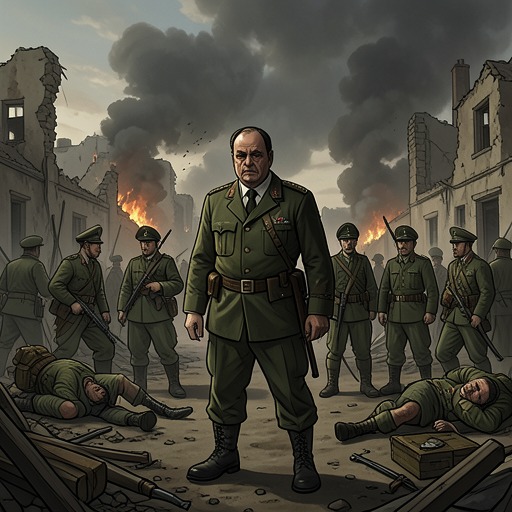
The war’s return is not limited to Fidelis’s account of Johannes. When Delphine tells him about her father Roy’s confession, Fidelis knows that she considers the revelation important, but he cannot follow her words. His attention is overtaken by an involuntary sequence of the men he killed, as though his mind were paging through an album of death. One image becomes especially fixed: a blond soldier resembling Pouty Mannheim reaching for a tin cup, then opening his mouth as if to begin a song before Fidelis’s bullet struck him. The memory ends not in a recognizable face but in what Fidelis experiences as a face emptied out, one that continues to exist in his mind whenever the album opens.
Fidelis tries to contain these memories by imagining himself standing on the album’s black cover and holding it shut beneath the hobnailed boots he wore in the war. The effort brings the battlefield back with it: mud rises around his boots, and the memories carry the filth and death he associates with his wartime existence. He recalls himself as cold-blooded and seemingly invincible, drawing enemy fire upon himself and those around him, and understands why other soldiers feared and hated him, with Johannes as the exception. The image of shutting the book therefore reveals both a defense and its limit: Fidelis can attempt to suppress the past, but he cannot prevent its return.
The scene also makes visible how trauma obstructs intimacy even when someone is trying to confide in him. Delphine’s disclosure concerns Roy and the burden she has taken on in interpreting his actions; Fidelis’s memories cut across her story until he can no longer hear what she is saying. He recognizes her distress and turns toward her, but his response follows an inward effort to still his heart, breath, and thoughts. The scene does not present their closeness as a cure for the war. Rather, it places Delphine’s attempt to speak beside Fidelis’s recurring inability to remain fully present, showing how separate histories of violence can meet without becoming interchangeable.
The Loss of Stillness
Afterward, walking away from the little house in the middle of the night, Fidelis feels his blood moving through him with unfamiliar force. He nearly loses his footing and shouts into the open prairie; with no echo returning, he imagines the sound traveling around the world. The shout makes the change legible to him: he has lost the capacity for utter cessation, the practiced stillness by which he could slow his heart and draw only the slightest breath. Yet he no longer regards that stillness as necessary for survival. The shift does not erase the memories that have surfaced, but it marks a change in how he understands the discipline that once helped him endure them.
Afterlives of War and the Limits of Bearing Witness
Fidelis’s private memories belong to a wider field of violence that the novel refuses to make easy to assimilate. When Delphine later considers the slaughter of Jewish civilians in Germany, she fears that Fidelis and Tante have let political change and their family’s prosperity obscure what is happening. Her fear does not establish what Fidelis knows or has done in the present; it shows that his wartime silence sits beside another silence, one shaped by the family’s response to Nazi persecution. Delphine’s unresolved question makes the cost of not speaking extend beyond the battlefield and into the moral choices of civilian life.
The account of Minnie’s childhood offers a stark contrast to Fidelis’s inward, fragmentary recollections. Roy recounts how Minnie survived the massacre at Wounded Knee: her father was killed, and Minnie escaped through the violence before following tracks in the snow to a mission. The story is told to Delphine, not by Fidelis, and it should not be mistaken for an episode in his own memory. Its presence nevertheless broadens the book’s treatment of historical trauma: violence can persist in a family through a survivor’s life and through the stories later told about what happened. The narrative keeps distinct the histories of war, persecution, and Indigenous massacre while placing them in a shared landscape of loss and belated telling.
The same attention to what survives appears in the later scenes of family and public remembrance. At a prisoner-of-war camp in Minnesota, Erich joins other German prisoners in singing, while privately longing for Ludwigsruhe and keeping his family identity at a distance. Years later, when Markus learns of a silent Waldvogel prisoner who sings, he brings the news to Fidelis; the fact that the prisoner is Erich is not yet confirmed in that conversation. The exchange recalls the importance of song in Fidelis’s story of Johannes, whom he sang to before leaving him behind. Music does not explain or undo the loss, but it gives memory a form that can pass between people when direct speech has failed.
In 1954, at the unveiling of a monument to those killed in the bombing of Ludwigsruhe, surviving master butchers gather to sing. Fidelis has practiced with the remaining men, and his voice rises with theirs; Delphine, listening, imagines smoke and ash issuing from their mouths as they sing. The image makes public ceremony feel neither like uncomplicated commemoration nor like release. The war’s dead are buried, yet its residue remains perceptible to Delphine in the song. Across the novel, Fidelis’s trauma is therefore rendered through recurrence—silence, involuntary images, a story finally told, and music shared—rather than through a single act of recovery. His changed relation to stillness matters because it marks a loosening of one survival practice, not the disappearance of the past.